#include <mitkWiiMoteThread.h>
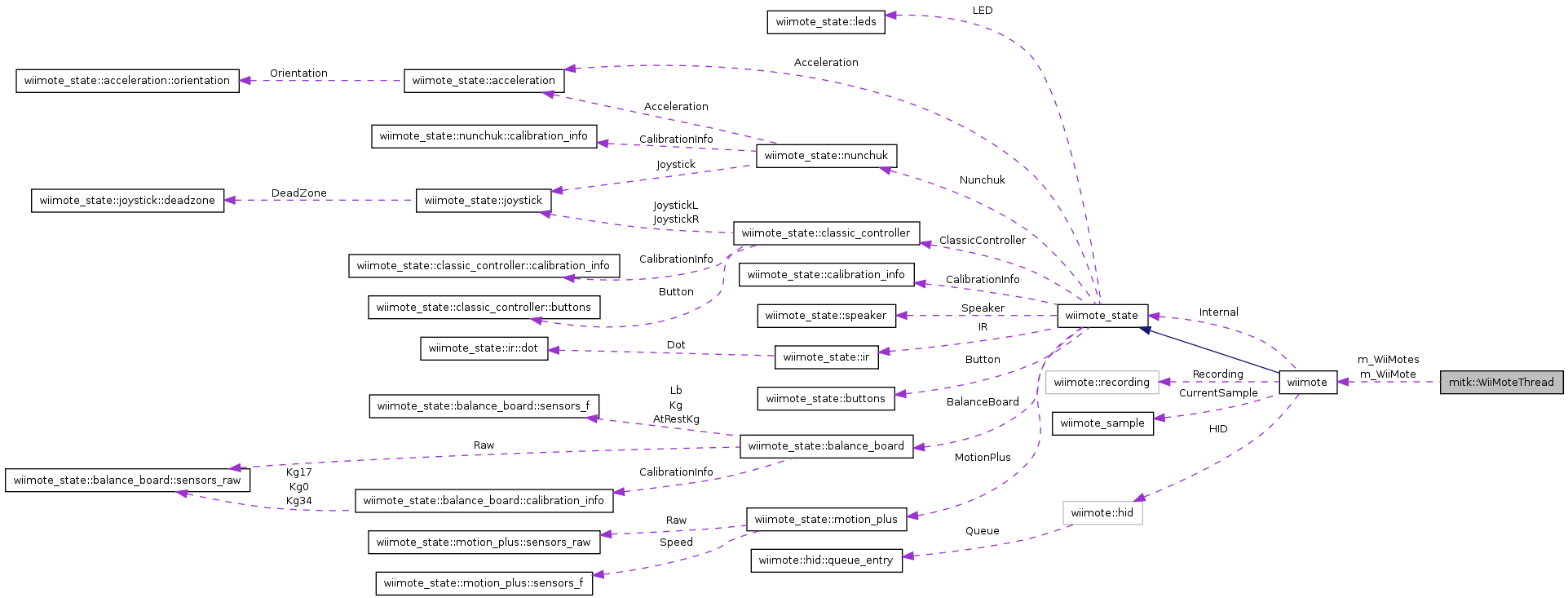
Public Types | |
| typedef itk::ReceptorMemberCommand < mitk::WiiMoteAddOn > | ReceptorCommand |
| typedef ReceptorCommand::Pointer | ReceptorCommandPointer |
Public Member Functions | |
| WiiMoteThread () | |
| ~WiiMoteThread () | |
| virtual void | SetSleepTime (int _arg) |
| virtual int | GetSleepTime () const |
| void | Run () |
| void | StartWiiMote () |
| void | StopWiiMote () |
| void | ReconnectWiiMote () |
| void | DetectWiiMotes () |
| void | WiiMoteIRInput () |
| void | WiiMoteButtonPressed (int buttonType) |
| void | WiiMoteCalibrationInput () |
Static Public Member Functions | |
| static void | OnStateChange (wiimote &remote, state_change_flags changed, const wiimote_state &newState) |
| static ITK_THREAD_RETURN_TYPE | StartWiiMoteThread (void *data) |
Definition at line 21 of file mitkWiiMoteThread.h.
| typedef itk::ReceptorMemberCommand<mitk::WiiMoteAddOn> mitk::WiiMoteThread::ReceptorCommand |
Definition at line 26 of file mitkWiiMoteThread.h.
| typedef ReceptorCommand::Pointer mitk::WiiMoteThread::ReceptorCommandPointer |
Definition at line 29 of file mitkWiiMoteThread.h.
| mitk::WiiMoteThread::WiiMoteThread | ( | ) |
Definition at line 23 of file mitkWiiMoteThread.cpp.
References wiimote::CallbackTriggerFlags, wiimote::ChangedCallback, CONNECTED, IR_CHANGED, and OnStateChange().
: m_MultiThreader(itk::MultiThreader::New())
, m_WiiMoteThreadFinished(itk::FastMutexLock::New())
, m_StopWiiMote(false)
, m_ThreadID(-1)
, m_LastRecordTime(0)
, m_ReadDataOnce(false)
//, m_SkipTimeSteps(4)
//, m_CurrentTimeStep(0)
, m_SleepTime(SLEEPDEFAULT)
, m_InCalibrationMode(false)
{
  // uses state-change callback to get notified of extension-related
  // events OnStateChange must be static, otherwise the this-operator
  // will be used and this callback can't convert it into the typedef
  // defined in the wiiyourself library
  m_WiiMote.ChangedCallback = &mitk::WiiMoteThread::OnStateChange;

  // allows flags to trigger a state change
  m_WiiMote.CallbackTriggerFlags = (state_change_flags) (CONNECTED | IR_CHANGED);
}
| mitk::WiiMoteThread::~WiiMoteThread | ( | ) |
Definition at line 45 of file mitkWiiMoteThread.cpp.
{
}
| void mitk::WiiMoteThread::DetectWiiMotes | ( | ) |
TODO Detects all available Wiimotes.
Definition at line 199 of file mitkWiiMoteThread.cpp.
{
  //unsigned detected             = 0;
  //unsigned connectionTries = 0;

  //while(detected < 3 || connectionTrys < 5)
  //{
  //  ++connectionTrys;
  //
  //  wiimote* newWiiMote;

  //  if(!newWiiMote->Connect(wiimote::FIRST_AVAILABLE))
  //    break;

  //  MITK_INFO << "New WiiMote detected :: Assigned ID: " << detected;
  //  m_WiiMotes[detected++] = newWiiMote;
  //}
}
| virtual int mitk::WiiMoteThread::GetSleepTime | ( | ) | const [virtual] |
| void mitk::WiiMoteThread::OnStateChange | ( | wiimote & | remote, |
| state_change_flags | changed, | ||
| const wiimote_state & | newState | ||
| ) | [static] |
Allows to set report types, detects extensions and responds to connect/disconnect
events of extension, such as MotionPlus.
NOTE: don't access the public state from the 'remote' object here, as it will be out-of-date (it's only updated via RefreshState() calls, and these are reserved for the main application so it can be sure the values stay consistent between calls). Instead query 'new_state' only.
| remote | the old state of the connected Wii remote |
| changed | the state change of the Wii remote |
| newState | the new state, after the change is applied (i.e. new extension connected) |
Definition at line 49 of file mitkWiiMoteThread.cpp.
Referenced by WiiMoteThread().
{
  // TODO check for extension and configure
}
| void mitk::WiiMoteThread::ReconnectWiiMote | ( | ) |
Reconnects the Wiimote in case the connection is lost.
Definition at line 191 of file mitkWiiMoteThread.cpp.
References wiimote::FIRST_AVAILABLE, and MITK_INFO.
{
  if(m_WiiMote.Connect(wiimote::FIRST_AVAILABLE))
  {
    MITK_INFO << "WiiMote reconnected..";
  }
}
| void mitk::WiiMoteThread::Run | ( | ) |
Starts the thread for the Wiimote.
Definition at line 54 of file mitkWiiMoteThread.cpp.
{
  m_ThreadID = m_MultiThreader->SpawnThread(this->StartWiiMoteThread, this);
}
| virtual void mitk::WiiMoteThread::SetSleepTime | ( | int | _arg ) | [virtual] |
| void mitk::WiiMoteThread::StartWiiMote | ( | ) |
Connects the Wiimote and allows access to its functionality.
Definition at line 76 of file mitkWiiMoteThread.cpp.
References CONNECTED, wiimote::FIRST_AVAILABLE, wiimote::IN_BUTTONS_ACCEL_IR, mitk::Key_A, mitk::Key_Home, MITK_INFO, and NO_CHANGE.
Referenced by StartWiiMoteThread().
{
  // mutex lock should be inside each method, but since
  // the driver is external, one would have to change it

  // transfers the execution rights to the WiiMote thread
  m_WiiMoteThreadFinished->Lock();

  // is needed in case the Wiimote was deactivated
  // while the application is running
  this->m_StopWiiMote = false;

  // transfers the execution rights back to the main thread
  m_WiiMoteThreadFinished->Unlock();

  while(CONNECTED && !m_StopWiiMote)
  {
    // connection process
    if(m_WiiMote.Connect(wiimote::FIRST_AVAILABLE))
    {
      m_WiiMoteThreadFinished->Lock();

      MITK_INFO << "WiiMote connected..";

      // 0x00 none
      // 0x0f all leds
      // 0x01 first led
      // 0x02 second led
      // 0x03 third led
      // 0x04 fourth led
      m_WiiMote.SetLEDs(0x01);

      // use a non-extension report mode (this gives us back the IR dot sizes)
      m_WiiMote.SetReportType(wiimote::IN_BUTTONS_ACCEL_IR);

      m_WiiMoteThreadFinished->Unlock();

      break;
    }
  }

  // update and settings process
  while(!m_WiiMote.Button.Minus() && !m_StopWiiMote )
  {
    m_WiiMoteThreadFinished->Lock();
    while(m_WiiMote.RefreshState() == NO_CHANGE)
    {
      itksys::SystemTools::Delay(1);
    }
    m_WiiMoteThreadFinished->Unlock();

    m_WiiMoteThreadFinished->Lock();
    if(!m_InCalibrationMode)
    {
      this->WiiMoteIRInput();
    }
    else
    {
      this->WiiMoteCalibrationInput();
    }
    m_WiiMoteThreadFinished->Unlock();

    if(m_WiiMote.Button.Home())
      this->WiiMoteButtonPressed(mitk::Key_Home);

    if(m_WiiMote.Button.A())
    {
      this->WiiMoteButtonPressed(mitk::Key_A);

      // necessary to avoid sending the movementvector
      // instead of the raw coordinates for the calibration
      if(this->m_InCalibrationMode)
      {
        this->m_InCalibrationMode = false;
      }
      else
      {
        this->m_InCalibrationMode = true;
      }

      itksys::SystemTools::Delay(3000);
    }

    if(m_WiiMote.ConnectionLost())
    {
      m_WiiMoteThreadFinished->Lock();
      this->ReconnectWiiMote();
      m_WiiMoteThreadFinished->Unlock();
    }

    //m_WiiMoteThreadFinished->Lock();
    //m_WiiMote.SetRumble(m_WiiMote.Button.B());
    //m_WiiMoteThreadFinished->Unlock();
  }

  //if(m_WiiMote.IsConnected() && m_StopWiiMote)
  //{
    //clean up
    m_WiiMoteThreadFinished->Lock();
    m_WiiMote.Disconnect();
    m_WiiMoteThreadFinished->Unlock();

    MITK_INFO << "WiiMote disconnected..";
  //}


  return;
}
| ITK_THREAD_RETURN_TYPE mitk::WiiMoteThread::StartWiiMoteThread | ( | void * | data ) | [static] |
Helper function, because the itk::MultiThreader can only
start a new thread with a static member function.
Definition at line 59 of file mitkWiiMoteThread.cpp.
References StartWiiMote().
{
  // extract this pointer from Thread Info structure
  struct itk::MultiThreader::ThreadInfoStruct * pInfo = (struct itk::MultiThreader::ThreadInfoStruct*)pInfoStruct;
  if (pInfo == NULL)
    return ITK_THREAD_RETURN_VALUE;

  if (pInfo->UserData == NULL)
    return ITK_THREAD_RETURN_VALUE;

  mitk::WiiMoteThread* wiiMoteThread = static_cast<mitk::WiiMoteThread*>(pInfo->UserData);
  if (wiiMoteThread != NULL)
    wiiMoteThread->StartWiiMote();

  return ITK_THREAD_RETURN_VALUE;
}
| void mitk::WiiMoteThread::StopWiiMote | ( | ) |
Stops the running thread.
Definition at line 186 of file mitkWiiMoteThread.cpp.
{
  this->m_StopWiiMote = true;
}
| void mitk::WiiMoteThread::WiiMoteButtonPressed | ( | int | buttonType ) |
Reads incoming data from buttons. After processing the data
(e.g. computations, assigning commands...) fires Wiimote events accordingly.
| buttonType | the type of button, that was used to trigger this event |
Definition at line 272 of file mitkWiiMoteThread.cpp.
References mitk::BS_NoButton, mitk::CallbackFromGUIThread::CallThisFromGUIThread(), mitk::CallbackFromGUIThread::GetInstance(), mitk::WiiMoteAddOn::GetInstance(), mitk::WiiMoteButtonEvent::MakeObject(), and mitk::WiiMoteAddOn::WiiMoteButtonPressed().
{
  m_Command = ReceptorCommand::New();
  m_Command->SetCallbackFunction(mitk::WiiMoteAddOn::GetInstance(), &mitk::WiiMoteAddOn::WiiMoteButtonPressed);

  mitk::WiiMoteButtonEvent e(mitk::Type_WiiMoteButton, mitk::BS_NoButton, mitk::BS_NoButton, buttonType);
  mitk::CallbackFromGUIThread::GetInstance()->CallThisFromGUIThread(m_Command, e.MakeObject());
}
| void mitk::WiiMoteThread::WiiMoteCalibrationInput | ( | ) |
Reads incoming data from the IR camera. Afterwards the raw x and y coordinates
are stored in an event and fired as an event.
Definition at line 281 of file mitkWiiMoteThread.cpp.
References mitk::CallbackFromGUIThread::CallThisFromGUIThread(), mitk::CallbackFromGUIThread::GetInstance(), mitk::WiiMoteAddOn::GetInstance(), IR_CHANGED, mitk::WiiMoteCalibrationEvent::MakeObject(), and mitk::WiiMoteAddOn::WiiMoteCalibrationInput().
{
  if(IR_CHANGED && m_WiiMote.IR.Dot[0].bVisible)
  {
    m_Command = ReceptorCommand::New();
    m_Command->SetCallbackFunction(mitk::WiiMoteAddOn::GetInstance(), &mitk::WiiMoteAddOn::WiiMoteCalibrationInput);

    mitk::WiiMoteCalibrationEvent e(m_WiiMote.IR.Dot[0].RawX,m_WiiMote.IR.Dot[0].RawY);
    mitk::CallbackFromGUIThread::GetInstance()->CallThisFromGUIThread(m_Command, e.MakeObject());
  }

  itksys::SystemTools::Delay(m_SleepTime);
}
| void mitk::WiiMoteThread::WiiMoteIRInput | ( | ) |
Reads incoming data from the IR camera. After processing the data
(e.g. computations, assigning commands...) fires Wiimote events accordingly.
Definition at line 218 of file mitkWiiMoteThread.cpp.
References mitk::CallbackFromGUIThread::CallThisFromGUIThread(), mitk::CallbackFromGUIThread::GetInstance(), mitk::WiiMoteAddOn::GetInstance(), IR_CHANGED, mitk::WiiMoteIREvent::MakeObject(), TIMELIMIT, and mitk::WiiMoteAddOn::WiiMoteInput().
{
  if(IR_CHANGED && m_WiiMote.IR.Dot[0].bVisible)
  {
    //m_CurrentTimeStep++;
    //if(m_CurrentTimeStep > m_SkipTimeSteps)
    //{
    m_Command = ReceptorCommand::New();
    m_Command->SetCallbackFunction(mitk::WiiMoteAddOn::GetInstance(), &mitk::WiiMoteAddOn::WiiMoteInput);

    double tempTime(itksys::SystemTools::GetTime());
    float inputCoordinates[2] = {m_WiiMote.IR.Dot[0].RawX, m_WiiMote.IR.Dot[0].RawY};
    mitk::Point2D tempPoint(inputCoordinates);

    // if the last read data is not valid,
    // because the thread was not started
    if(!m_ReadDataOnce)
    {
      m_ReadDataOnce = true;
    }
    else // there is old data available - calculate the movement and send event
    {
      // this time constraint allows the user to move the camera
      // with the IR sender (by switching the IR source on and off)
      // similiar to a mouse (e.g. if you lift the mouse from the
      // surface and put it down again on another position, there
      // was no input. Now the input starts again and the movement
      // will begin from the last location of the mouse, although
      // the physical position of the mouse changed.)
      if ((tempTime-m_LastRecordTime) < TIMELIMIT)
      {
        mitk::Vector2D resultingVector(m_LastReadData-tempPoint);
        mitk::WiiMoteIREvent e(resultingVector, tempTime);
        mitk::CallbackFromGUIThread::GetInstance()->CallThisFromGUIThread(m_Command, e.MakeObject());
      }
    }
    m_LastRecordTime = tempTime;
    m_LastReadData = tempPoint;

    itksys::SystemTools::Delay(m_SleepTime);

    //m_CurrentTimeStep = 0;
    //}
  }

  //read data
  //MITK_INFO << "Pitch: " << m_WiiMote.Acceleration.Orientation.Pitch;
  //MITK_INFO << "Roll: " << m_WiiMote.Acceleration.Orientation.Roll;

  //MITK_INFO << "X: " << m_WiiMote.Acceleration.Orientation.X;
  //MITK_INFO << "Y: " << m_WiiMote.Acceleration.Orientation.Y;
  //MITK_INFO << "Z: " << m_WiiMote.Acceleration.Orientation.Z;
}
 1.7.2
1.7.2

